

Preview: Tulsa Comes to Birmingham
Fielding his best team since the days of Kenneth Lofton, can Eric Konkol beat UAB for the first time since 2021?
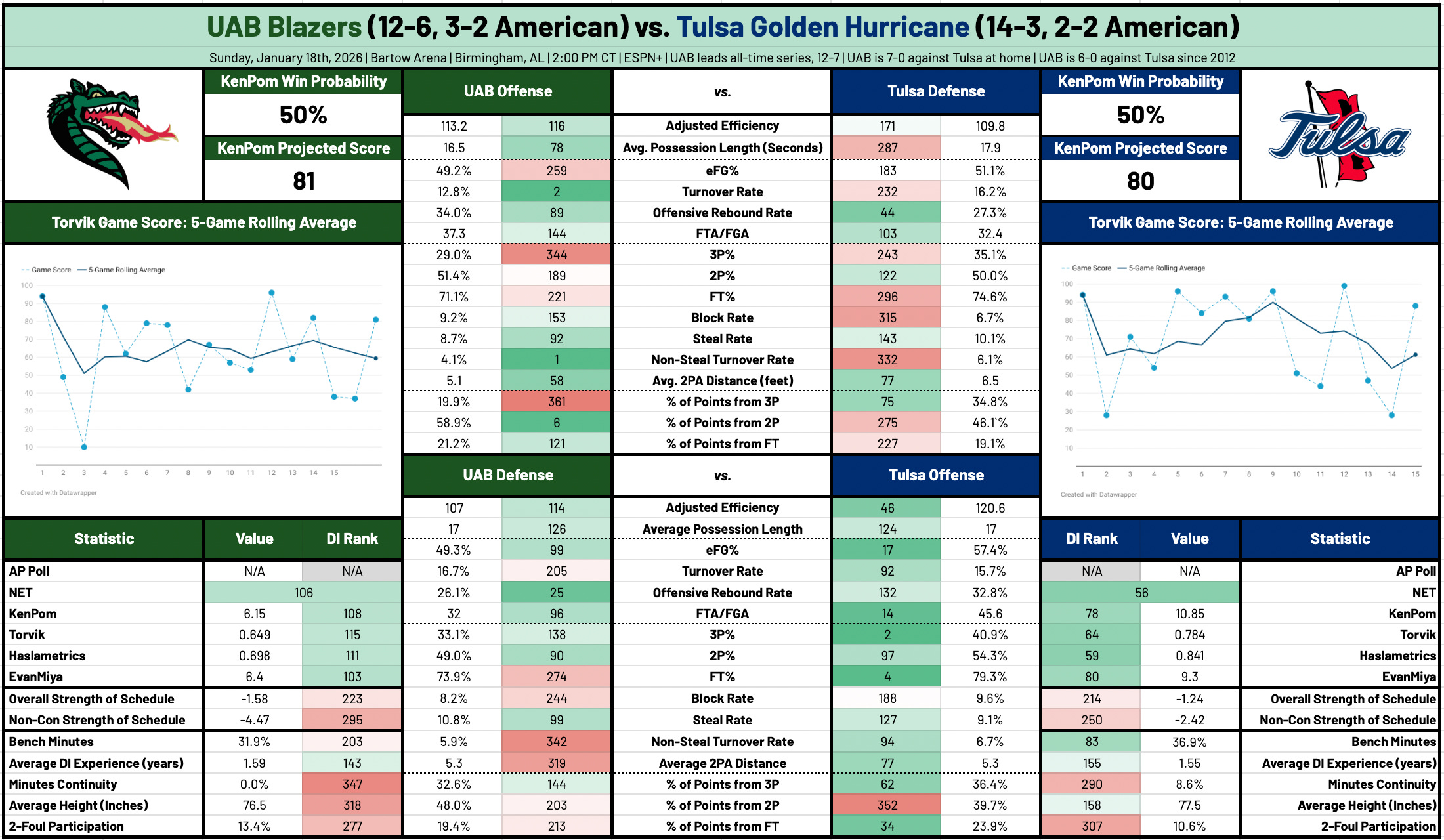
Eric Konkol was a main character of the Ehsan and early Kennedy eras, the architect of the Louisiana Tech teams that gave UAB some of its most memorable battles of the last decade.
However, since he left Tech for Tulsa in 2022 and UAB joined the American in 2023, Konkol and his Golden Hurricane program have been all but forgotten, shunted into irrelevance by Memphis, North Texas, Florida Atlantic, and South Florida.
It does bring me some degree of joy to announce that Konkol has at last returned to prominence, putting together a cadre of sharpshooters that rolled through the non-conference slate like a knife through hot butter — the Golden Hurricane’s sole loss came in immensely unlucky fashion against erstwhile Tulsa guard PJ Haggerty and his Kansas State squad. Say what you will about Konkol as a coach — the sheen of his Louisiana Tech accomplishments has somewhat dimmed after his struggles in the American — but what Tulsa (KenPom #77, higher than all of its conference peers but South Florida) has accomplished this year is unambiguously impressive.
The question of whether Tulsa is for real is still unanswered, especially after the Golden Hurricane fell to North Texas and USF in back-to-back outings. Is the jump-shooting regression monster coming for Tulsa, and if so, can they survive it? Whatever the answer to that question may be, UAB needs to beat Konkol’s squad today if the Blazers truly want to contend for a conference title. Just like old times.
Tulsa Offense
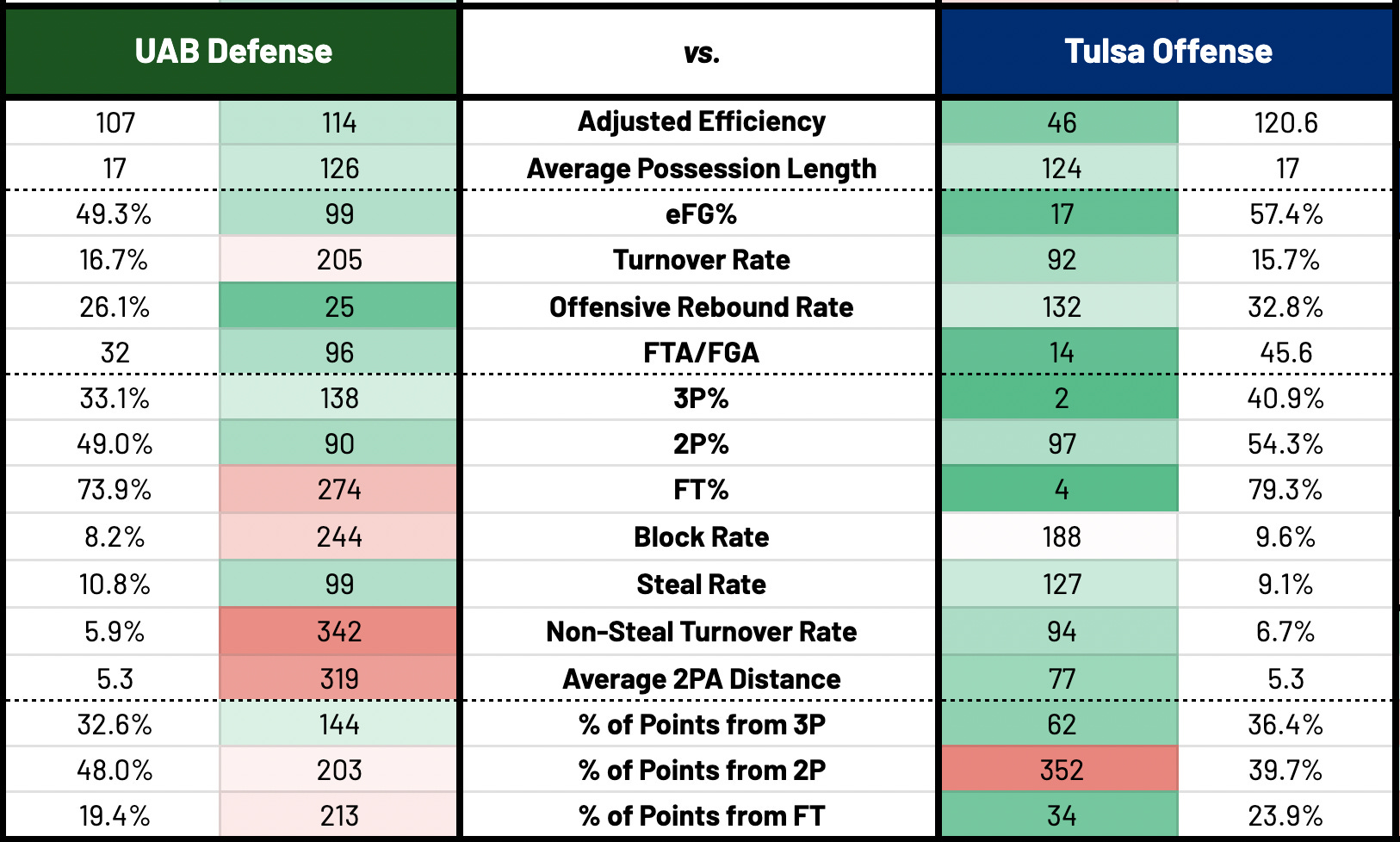
This unit is an absolutely devastating one, the most effective offense Tulsa has fielded since the days of Buzz Peterson and Bill Self. The Golden Hurricane have been quick to take triples during the Konkol era, but they’ve never had the personnel to do it efficiently — until now. After several years of underwhelming offensive showings, Tulsa struck gold in the transfer portal, constructing an analytically pure, rim-and-three-oriented attack that attempts just 11.1% of its field goals from the midrange. Konkol’s squad ranks 45th in the country (and first in the conference) in KenPom offensive rating, having nailed a nation-leading 41% of its three-pointers.
You may remember Ian Smikle (4.4 PPG, 4.2 RPG), Tulsa’s starting center during the 2024-2025 campaign and the only TU player to score more than ten points during the Golden Hurricane’s most recent visit to Bartow Arena, in which they were thrashed 83-51. He returns, as does forward Tyler Behrend (5.3 PPG, 4.1 RPG), who saw little playing time last year but has now become the Golden Hurricane’s starting five. However, neither man is a floor-stretcher, and thus neither man takes many shots in the new-look Tulsa attack, which has all but eschewed post-ups and rolls in favor of guard and wing-driven rim pressure, cuts from the perimeter, and catch-and-shoot triples.
Let’s start, ironically, with a guy who rarely shoots threes: guard Tylen Riley (14.5 PPG, 3.6 APG), who has become a breakout mid-major star after a forgettable two-year stint at Cal Baptist. Although Tulsa prefers to operate at a reasonably fast pace, they’re not the transition-obsessed unit they were in 2023-2024; Riley isn’t PJ Haggerty. Most of his touches come in the half court, where he serves as the fulcrum of Tulsa’s drive-and-kick offense, whirling around dribble handoffs and relentlessly attacking the bucket.
Riley isn’t a great finisher, but he draws free throws at a monstrous rate and makes them at a sparkling 87% clip. If the opposing defense overcommits, the pass-first Riley will kick it out to one of Tulsa’s many lethal shooters; per hoop-explorer, Riley is in the 99th percentile of drive-and-kick efficiency.
Riley boasts an assist rate of 27.1%, among the highest marks in the American. A 20.6% turnover rate is unsightly and, along with his lack of three-point shooting, represents perhaps Riley’s greatest offensive weakness. Nevertheless, his passing skills, along with the gravity he creates, shouldn’t be discounted, as Riley is able to pound the rim, find open perimeter shooters, and hit cutters like forward David Green (16.1 PPG, 4.9 RPG).
Green, who currently ranks third on KenPom’s all-conference team, is the next player UAB has to worry about — he’s shooting 64.7% from three in American play. The Rhode Island transfer is a pure scorer, a 6’7”, 225-pound wing/forward who drains triples at a 39.2% clip, a strong rim attacker who connects on 62% of his two-pointers, Tulsa’s best scorer off offensive rebounds, and an intimidating force in transition.
Beside Riley in the backcourt is guard Miles Barnstable (13.7 PPG, 1.8 APG), a hyper-efficient catch-and-shoot threat who has made 42.2% of his triples and 94.1% (!!!) of his free throws on the year. Barnstable primarily lives behind the arc, but he’s also capable of attacking the rim and kicking it out to shooters. His KenPom player comparison, coincidentally, is a supercharged version of Tony Toney.
Make sure you don’t come down under him — Barnstable leads Tulsa in fouls drawn on three-point attempts.
Wing Ade Popoola (9.5 PPG, 3.4 RPG), who we’ll talk about more later, is another perimeter-oriented guy you don’t want taking triples — he’s making 46.6% of them — although he struggles a little bit with turnovers. Fellow wing Myles Rigsby (8.8 PPG, 2.1 APG), who comes off the bench, is the rare member of this team who can’t shoot threes; however, he makes up for it with passing chops and impressive numbers as a cutter and a rim attacker.
One frustrating thing about playing Tulsa is that there’s never truly a moment of respite. Ten members of their rotation play more than 10 minutes per game, and other than Smikle, all of them have a positive EvanMiya OBPR. Forward Romad Dean (5.6 PPG, 3.8 RPG) is a pick-and-pop threat; true freshman guard Jaylen Lawal (7.9 PPG, 1.6 APG) is an improving driver, a capable passer, and a strong three-point shooter who recently dropped 25 points against Rice; wing KJ Martin (2.6 PPG, 2.1 RPG) has been solid in limited minutes. Practically all of the Golden Hurricane’s lineups can both pressure the rim and shoot the three.

Per hoop-explorer, UAB’s defense is most effective against frontcourt-driven actions like post-ups, of which Tulsa runs very few. A positive note, however: although the Blazers don’t have the best efficiency numbers at the cup, they’ve generally been pretty good about limiting opposing rim rates and forcing opponents to take tough two-point shots. In conference play, Riley has struggled to assert himself on drives, posting a two-point percentage of just 44.4%; while it will prove difficult for UAB to contain Green, who just scored 34 points against the Izaiyah Nelson-led USF frontline, there’s a path to limiting Tulsa’s interior effectiveness if UAB sticks with cutters, walls off the paint, and limits defensive fouls, all things Andy Kennedy’s squad is middling-to-good at.
At the end of the day, though, this one might come down to jump-shooting variance. North Texas managed to hold Tulsa to a season-low 14 three-point attempts during their win over the Golden Hurricane; it is unlikely the Blazers, who play much less drop defense than the Mean Green and generally give up a lot of unguarded triples, will be able to replicate that feat. If UAB wins the turnover battle and limits Tulsa on the offensive glass, two things they are fully capable of doing, they’ll put themselves in a position to win with a shot volume edge, but little else will matter if the Golden Hurricane shoot 45% on what will probably be 20 or more three-point attempts.
The question that will define the game: can Tulsa’s roster of players who combined to shoot about 36% from beyond the arc before this season maintain the best three-point percentage in program history? We’ll see later today!
Tulsa Defense
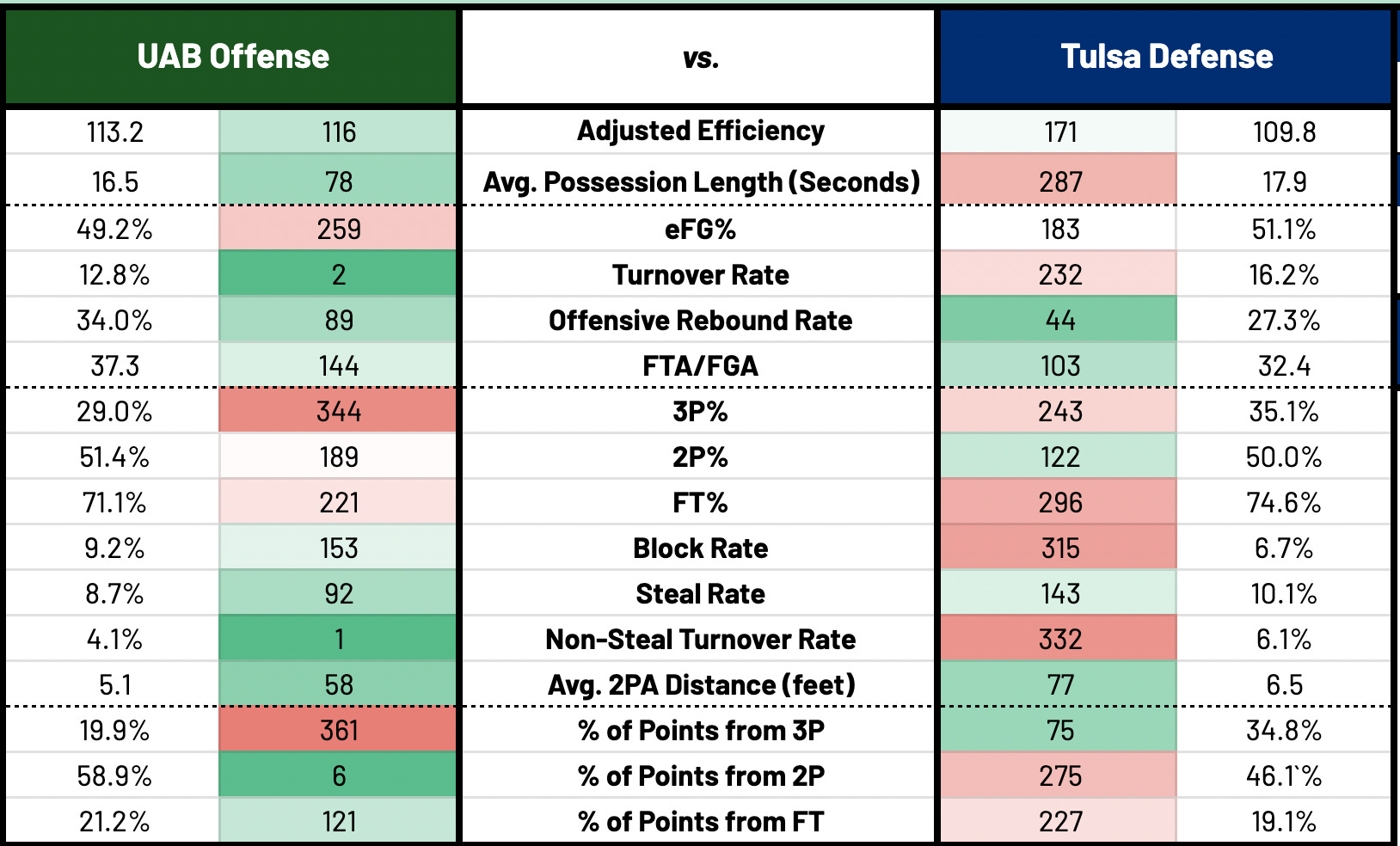
Last season, Tulsa fielded one of the worst defensive units in its proud history. Although the Golden Hurricane’s backline wasn’t quite as porous as those of Charlotte, Temple, and, disconcertingly, UAB, that wasn’t saying much. Eric Konkol’s squad finished the campaign ranked 244th in KenPom’s defensive efficiency metric, marking a steep fall from grace for a program that once ruled the WAC on the shoulders of intimidators like Eric Coley and Jerome Jordan.
Tulsa’s drop coverage, anchored by forwards Smikle and Jared Garcia, was effective in its intended purpose of denying opponents the rim and the three-point line: when facing the Golden Hurricane, American Conference teams attempted nearly 30% of their total field goals from the midrange. However, Tulsa’s foes made those jumpers at a reasonably high clip, and when they actually reached the rim, it wasn’t pretty for TU.
That’s not to mention offensive rebounding — Golden Hurricane opponents scored a whopping 18.9% of their points on second-chance opportunities. You may recall UAB’s aforementioned 83-51 beatdown of Tulsa, during which the Blazers shot 70% at the rim while posting 17 second-chance points.
Despite retaining Smikle and Behrend, Tulsa has (understandably) scratched last year’s system. No longer is TU’s defensive identity oriented around forcing midrange jumpers; instead, the Golden Hurricane welcome the triple while denying interior shots. Through four games of conference play, Tulsa’s opponents have launched three-pointers on a sky-high 46.4% of their field goal attempts, an eye-popping number when compared to last season’s mark of 36.4%. On drives, defenders are in the gaps early, walling up to prevent easy paint access.
Although no one is going to mistake Tulsa for a defensive powerhouse — for the second consecutive campaign, the Golden Hurricane are the American’s eighth-ranked team in KenPom defensive efficiency — the new strategy has paid dividends for Konkol’s squad, as it allows about 3.5 fewer points per 100 possessions than it did in 2024-2025. Tulsa has also used increased defensive rebounding and steal rates to increase the efficiency of its once-mediocre transition attack.
That steal rate is less the product of Tulsa’s system (the Golden Hurricane’s overall defensive turnover rate lingers at a middling 16.2%, and although Tulsa occasionally deploys a three-quarter press, they force few turnovers with it) and more the product of ballhawking, aggressive wings Popoola and Rigsby, the latter of whom rocks the highest steal percentage (4.0%) in the conference. You don’t have to watch a whole lot of Tulsa basketball to see who has the most active hands on the floor:
Although Tulsa’s scheme doesn’t call for much ball pressure, Popoola and Rigsby will take advantage of opportunities to be aggressive. Unsurprisingly, the Golden Hurricane’s wing duo is excellent at the point of attack, and the pair is often deployed against the opponent’s best dribble penetrators and ball-screen operators. Blessed with multiple capable ballhandlers, UAB boasts the lowest offensive steal percentage of any team in the conference, but the matchup of Westry/Robinson against Popoola/Rigsby is nevertheless one to watch.
Speaking of ball-screen operators, the Blazers’ pick-and-roll teams are primarily going to run into an aggressive drop coverage that sees Behrend/Smikle meet the handler near the level of the screen before backpedaling.
This differs from the drop Tulsa deployed last year because, in this case, the five-man is not content to sit back and allow the handler to work in the midrange; instead, the five-man confronts the handler, all but ignoring the roller until the handler picks up the ball (or until the on-ball defender fully recovers to the handler). This is not a trap or a hedge — Behrend/Smikle do not move above the level of the ball screen — but it is a way to discourage an off-the-dribble three-pointer and to prevent an open midrange jumper (the kind that would be encouraged by a deeper drop).
Thus, it’s not much of a surprise that Tulsa opponents take midrange jumpers on just 20% of their field goal attempts and only make 33.3% of them — the eighth-lowest mark in the nation, per hoop-explorer.
The elephant in the room: what happens to the ignored roller? Drop principles still apply — a tagging defender from the weak side provides help and tries his best to prevent the completion of a pocket pass — but if the handler manages to get the ball to the roller, devastation can occur, especially because Tulsa’s big men aren’t fantastic in rim defense (the Golden Hurricane allow an ugly 60% opposing shooting percentage at the cup) or as movers in space.
In their recent win over Tulsa, North Texas put up a scorching 1.36 points per possession on big cut-and-rolls, per hoop-explorer. Mean Green guards Je’Shawn Stevenson and David Terrell navigated the aggressive drop and connected multiple times with rolling forwards Josiah Shackleford and Dylan Arnett. At one point early in the second half, Stevenson threw a perfect pass to lifting guard Cole Franklin, unmarked on the weak side because his defender was tagging Shackleford. Before the Golden Hurricane could get set again, Franklin drove into the paint and kicked the ball out to forward Buddy Hammer for three.
North Texas provided UAB with a replicable blueprint to score against the Golden Hurricane; it helps that the Blazers possess multiple effective passers and rollers in Westry/Robinson and Lindsay-Martin/Rivera. Overall, signs are good for UAB’s big men: although Tulsa doesn’t allow many offensive rebounds, they’re one of the nation’s least efficient teams against putbacks, and they’re only moderately effective against post-ups, of which the Blazers run a lot of (although the Golden Hurricane tend to bring help against post-ups, and none of UAB’s bigs are fantastic passers).

In more discouraging news: someone, anyone on this team is going to have to make a three. Tulsa’s willingness to bring help into the gaps leaves them reasonably vulnerable to drive-and-kick triples, but UAB doesn’t generate many of those; the Golden Hurricane have been absolutely burned by self-created threes off the dribble, but, per hoop-explorer, there is not a single shot the Blazers have made at a less efficient clip than the off-the-dribble three.
South Florida beat Tulsa thanks to ten (!) triples from old friend Wes Enis, while North Texas, one of the few American teams that might be worse at shooting than UAB, knocked off the Golden Hurricane on the back of an eight-of-18 (44.4%) performance from beyond the arc. The Blazers can put themselves in a position to win by limiting turnovers, grabbing offensive rebounds, and feeding their big men down low, but this one, as previously stated, might come down to jump-shooting variance.
With Tulsa’s offense likely to bomb away, it’s difficult to see UAB’s path to victory if they don’t get at least one performance in the vein of Quaran McPherson against USF.