

After UAB’s disappointing New Year’s Eve loss to Wichita State, Andy Kennedy was left searching for answers.
Despite leading by as much as 16, the Blazers ferreted away their sizable lead in the second half, getting outscored by 18 and outrebounded by eight in one of their worst stretches of the campaign. Shotmaking, defense, energy; every aspect of UAB’s performance was scrutinized by a frustrated Kennedy.
“We’ve got to grow up,” Kennedy said. “We’ve got to understand that no one is going to give you anything, nor should they. And you’ve got to earn it, and just because you were the better team for about 20 minutes today doesn’t mean anything. You’ve got to keep playing.”
Kennedy shouldered partial responsibility for the Green and Gold’s slow start to league play, accepting blame for UAB’s failure to adequately defend Wichita State guard Kenyon Giles, the conference’s leading scorer. Giles sank the Blazers with a game-high 26 points and drained eight triples, including two daggers down the stretch.
However, the Blazers’ coach didn’t shy away from challenging his players. Much of Kennedy’s ire was directed at guard Chance Westry, who posted four points and zero rebounds over 31 minutes. According to Kennedy, the Blazers seemed “hesitant in that paint, hoping, praying, you know, not making definitive plays,” issues he said could only be fixed by an increase in effort.
“I mean, there’s got to be a determination from within that they want to change,” Kennedy said.
How’s that for determination?
On the first Sunday of the new year, UAB was resolute, moving past Wednesday’s struggles with a heart-stopping, double-overtime road victory over South Florida. It would be a laughable understatement to say it wasn’t always pretty — at multiple points, television cameras captured a hopeless Kennedy staring off into the Yuengling Center bleachers — but the Blazers never quit, responding with haymakers every time their backs were pressed against the wall.
The game’s script was familiar. Competitive in the opening minutes, UAB fell behind after a sloppy start to the second half. South Florida controlled the boards, becoming the rare opponent to out-rebound UAB by double digits. USF guard Wes Enis was unguardable from beyond the arc, scoring 36 points on a whopping ten triples; in a manner reminiscent of WSU’s Giles, Enis drained a late-game three that seemed to be the dagger.
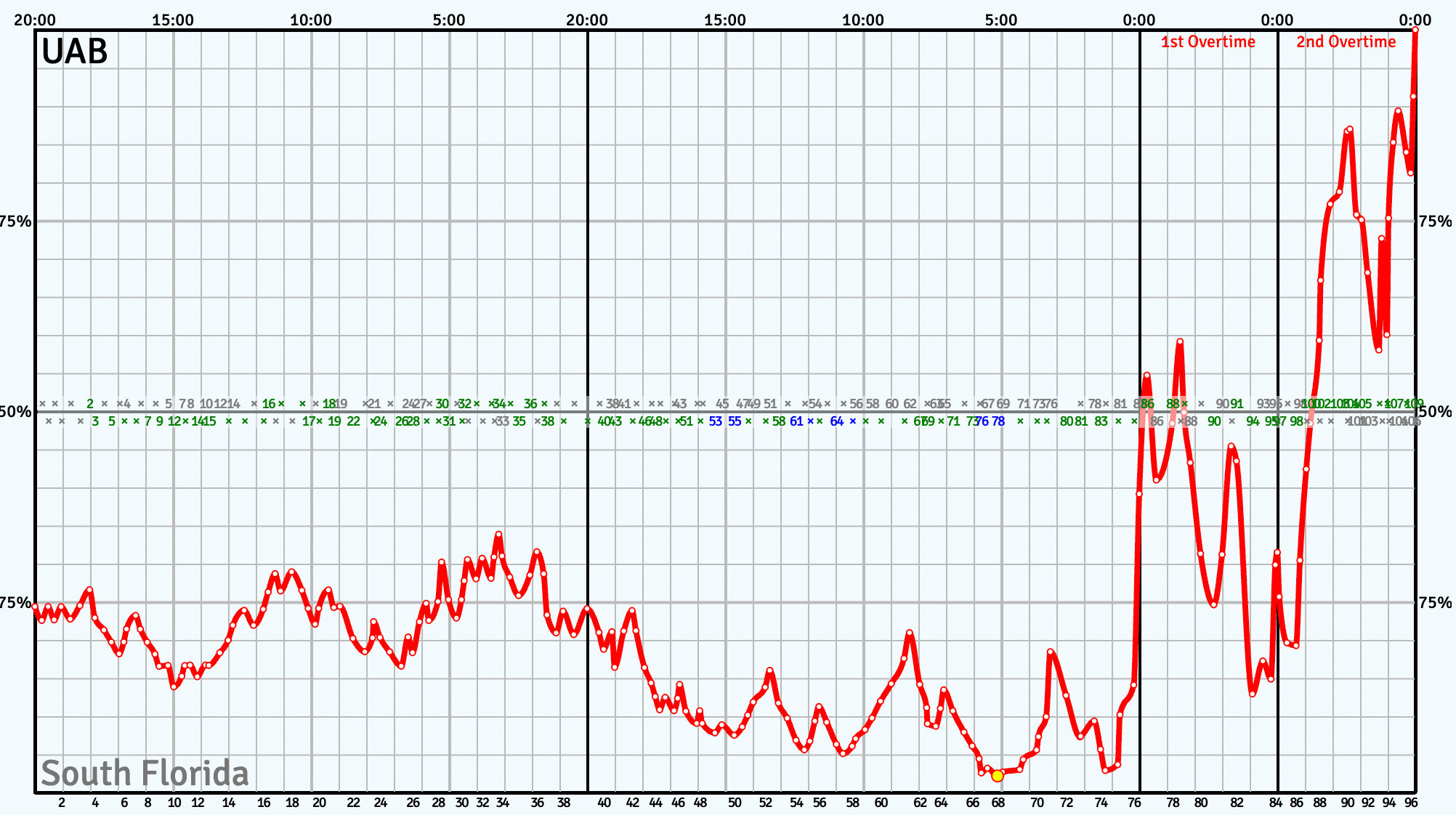
However, the fortitude UAB lacked against the Shockers was present in Tampa. In the face of overwhelming odds (less than three-in-100, according to KenPom), Kennedy’s squad managed to send the game to overtime after being down by 11 with less than six minutes left and down by five with less than 50 seconds left.
It got no easier from there, but, taking advantage of several mistakes made by the exhausted Bulls, UAB emerged from the marathon with its heads held high. In his postgame radio interview with David Crane and Steve Mitchell, Kennedy struck a markedly different tone than he did on December 31st.
“Despite getting out-rebounded by 12, despite losing 50-50 balls — actually, we won it by one — despite a lot of struggles offensively, which are kind of par for the course for this group, despite missing 12 free throws, including two front ends of one-and-ones, we won the most important category, and that was the one of determination,” Kennedy said. “I thought we were the most determined team, and I’m really, really proud of their fight.”
A Backyard Brawl
“Fight” is an appropriate descriptor of Sunday’s contest, which saw UAB and South Florida commit a combined 52 personal fouls and shoot a combined 79 free throws.
On paper, the game’s physical, paint-oriented nature favored the Bulls, a squad boasting two centers (6-foot-10 Izaiyah Nelson and 6-foot-9 Daimion Collins) taller than every player in the Blazers’ rotation. The second-shortest team in the American at full strength, UAB’s already-notable size issues were exacerbated by foul trouble, brought on by USF’s relentless rim attacks. With 7:40 remaining in regulation, Evan Chatman fouled out; with 54 seconds left in the first overtime, Daniel Rivera fouled out; 40 seconds later, Kyeron Lindsay-Martin fouled out. At the beginning of the final period, the 6’6” Westry was forced to take the tip for UAB, unsurprisingly losing to Nelson.
Nevertheless, the “Fighting Midgets,” as the Blazers were dubbed by Noah Dartmann, found a way to win, avoiding their first 0-2 start to conference play since the final campaign of the Ehsan era.


The Blazers’ height disadvantage certainly proved to be an obstacle. UAB gave up a season-high 17 offensive rebounds while grabbing just 12 of its own, losing the second-chance points battle 17 to 9. Nelson and wing Josh Omojafo wore down the Blazer backline all day long, combining to attempt 25 free throws and helping to drive Chatman, Rivera, and Lindsay-Martin out of the game. During the two overtime periods, Nelson took four trips to the line as Collins ripped down five boards against UAB’s gutted frontcourt.
However, the Blazers stayed afloat by limiting turnovers (committing eight to South Florida’s 14), getting high-leverage shotmaking from some unlikely suspects (we’ll get to that in a moment), and beating USF at its own game — drawing free throws.
“If we could get them to take a perimeter shot and we could secure the rebound, which was a problem for us all night, then I felt like offensively, we were going to be able to get some dribble penetration,” Kennedy said.
Despite suffering through a nightmarish afternoon from the floor, making just one of his 15 field goal attempts, Ahmad Robinson went eight-of-ten from the charity stripe. The probing Westry drew 13 free throws and drained eight of them, while Jacob Meyer went six-of-six from the line, converting multiple crucial and-one layups near the end of the game.
According to Kennedy, UAB’s frontcourt was “pretty effective” on offense — although Chatman was limited, Rivera put up an efficient 18 points, and Lindsay-Martin scored 11 off the bench — but the Blazers weren’t going to win unless their guards played bigger than their listed sizes, and did they ever. Behind the efforts of its backcourt, UAB generated 43 free throw attempts and made 31 of them; USF, conversely, finished 23-of-36 from the line. Meyer also posted a double-double, recording 11 rebounds in addition to his 19 points, while Robinson grabbed eight boards, half of them coming in the third and fourth periods.
Chance Westry Meets the Moment
In 2024, Nelson, USF guard Joseph Pinion, and USF coach Bryan Hodgson dealt UAB a backbreaking home loss while the trio was at Arkansas State. Sunday, the Blazers returned the favor.
Kennedy compared the two games in his presser, taking a playful shot at Westry in the process.
“Remember last year we were up like 20-something, and they came back and beat us when [Hodgson] was at Arkansas State in overtime?” Kennedy said. “That was probably about as improbable as us winning today. We look out there, we have to play basically two overtime periods with the tallest player on the floor being Chance Westry at 6-foot-6, and defensively, Chance plays at about 5-foot-6.”
As he’s made apparent, the UAB coach would have expressed it in much more explicit terms if he truly harbored frustration with Westry. After the Blazers’ December 14th loss to Troy, Kennedy called out the guard for a perceived lack of energy. Roughly two weeks later, he did the same thing, criticizing Westry for failing to corral a rebound during UAB’s loss to Wichita State.
Westry responded to Kennedy’s first challenge with a hyper-efficient, 31-point outing against Cleveland State. He answered his coach’s most recent call-out in a similar manner, pacing the Blazers with a team-high 24 points and six assists. Although he came off the bench for just the third time this season, benched in favor of Quaran McPherson, Westry displayed no signs of discouragement, immediately driving to the hoop and drawing a foul upon first entering the game. In combination with Lindsay-Martin, Westry gave the Blazers a much-needed early burst of energy.
Even in the second half, when his shot briefly stopped falling, Westry continued getting to the free throw line, tapping into the aggression Kennedy begged to see against Wichita State. Most critically, he served as the team’s go-to offensive option when it mattered most, posting 11 points on 100% shooting across the ten bonus minutes. He had a hand in UAB’s first eight points of the initial overtime and ultimately broke USF’s back in the final period, driving past an exhausted, flat-footed Pinion to give the Blazers a four-point lead that proved to be insurmountable.
Westry’s rebounding numbers still lagged — unlike his backcourt counterparts, he failed to dominate the glass, grabbing just two boards — but his hustle showed up on the defensive end, where he deflected several balls. With no hope of containing Nelson one-on-one with a foul-stricken frontcourt, UAB began deploying a 3-2 zone at the conclusion of regulation. Westry played a crucial role in heading the zone, which seemed to disrupt South Florida’s rhythm throughout both extra periods.
“Jacob [and] Chance I thought were really good with using hand-eye — length, as it relates to Chance — and getting our hands on some passes,” Kennedy said. “And then we had to go to that 3-2 zone, simply because we had no chance to guard them man-to-man. We went to the 3-2 zone, and I thought it was a really effective force in the overtimes.”
Roughly halfway into the season, it’s become clear that Westry is UAB’s best and most important player: he ranks second in the American Conference in Evan Miya’s BPR (behind only USF’s Nelson), and he leads the Blazers in Miya’s indispensability score by a significant margin. The Green and Gold will contend for a conference title if Westry continues playing like he did against South Florida, but that’s no guarantee: he hasn’t posted a triple-digit offensive rating in back-to-back games since November. Once again, Kennedy will be intently observing Westry during UAB’s Wednesday tilt against FAU.
Coming Up Clutch
UAB, notoriously, cannot make triples.
Westry, the Blazers’ leading scorer, has connected on eight of his 33 (24.2%) three-point attempts, while Meyer has made just 14 of 47 (29.8%). Although Chatman is capable of popping out to the perimeter, he’s still shooting 27% from beyond the arc. The team’s best shooter, therefore, is Robinson, who went 1-for-15 from the floor on Sunday. Ouch.
How, then, was UAB able to keep pace with a South Florida team whose starting shooting guard nailed ten triples on the afternoon? Not because of Meyer or Westry, who combined to go one-of-three from deep. Not because of Robinson, who, as one ESPN commentator put it, found himself unable to hit the side of a barn.
No — the Blazers’ Enis equivalent was McPherson, a man that entered the game having made two three-pointers on the season. In UAB’s loss to Wichita State, the Northern Illinois transfer was allocated just three minutes of playing time, a sight that has become familiar during the 2025-2026 campaign. Although McPherson saw stretches of usage against UNC Asheville, Cleveland State, and High Point, he’s been forced adapt to a new role after previously serving as one of NIU’s top offensive options, typically on the floor for roughly 20% of a given game, give or take a few minutes.
On a hunch, however, Kennedy gave McPherson his first start of the year against South Florida, sending him onto the floor in place of Westry.
It’s safe to say Kennedy’s instincts paid off. McPherson played a season-high 23 minutes, posted a season-high 17 points, and shot a career-high 75% from the floor, making four out of five three-point attempts and two out of three two-point attempts. With UAB having missed six of its last seven field goals and the clock ticking under seven minutes in the first half, McPherson caught fire, draining three triples in a 90-second span.
The first was a spot-up from the left corner; the second was off a stepback at the top of the circle; the final was a spot-up from the same location. By the time all was said and done, McPherson had turned a five-point Blazer deficit into a two-point Blazer lead.
“What a game by Q, huh?” Kennedy said. “You know, Coach Bartow used to talk about trusting your gut, trusting the instincts. I went with him in that lineup because I just felt like he’s always got good energy, and he’s kind of — he’s always positive. I need him just to talk to me every once in a while … But man, I thought he gave us a great lift early.”
McPherson one-upped himself about 32 minutes of game time later, when the Blazers’ win probability had dropped to just 12.9% at the end of the first overtime. Down 94-91 with 40 seconds on the clock, UAB needed a bucket, but Meyer came up short on a three-pointer; however, in one of its many late-game miscues, South Florida knocked the rebound out of bounds and allowed the Blazers to try again. In perhaps the most important moment of his young UAB career, Salim London drove around Pinion and converted a difficult layup over Nelson, cutting the Bulls’ lead to one. USF’s Isaiah Jones split a critical pair of free throws on the other end, and with less than 15 seconds remaining, UAB had a chance to stay alive.
Robinson grabbed the defensive rebound and maneuvered his way into a near-empty paint; however, perhaps unwilling to test the hulking Nelson after an ice-cold afternoon, he found McPherson standing in the left corner. In accordance with the game’s theme, what happened next wasn’t pretty — a mishandled reception forced McPherson to step inside the arc and attempt the least analytically-friendly shot of all time — but it worked. UAB 95, South Florida 95. Double overtime.
“I was going to shoot a three at first, but I caught it and I kind of bobbled it,” McPherson told Steve Irvine in an interview you need to read in its entirety. “ … I went right, pulled up and knocked it down.”
It wasn’t just McPherson who produced a memorable moment under pressure. With 3.6 seconds left in regulation and UAB down 83-81, Rivera, a sub-50% free-throw shooter, went two-for-two from the charity stripe; a single miss almost certainly would’ve spelled the Blazers’ doom.
“Daniel with two huge free throws,” Kennedy said. “I mean, goodness gracious. I mean, again, a testament to how much he has really, really improved in that area from a confidence standpoint. Two huge ones.”
And so on, and so forth. With the Blazers trailing by three early in the second overtime and the game threatening to slip away, Robinson, who hadn’t yet connected on a field goal, stepped back and hit an enormous triple, evaporating what would prove to be USF’s final lead of the afternoon. Meyer’s entire night was a masterclass in clutch scoring — all 19 of his points came after halftime — but he saved his most determined effort for last, diving after a loose ball to seal the Blazers’ victory in double overtime. Nearly every member of UAB’s rotation made a play that, in a less eventful game, would have been discussed for days.
A team might look “determined” and “clutch” one week and uninterested the next; there is, of course, no guarantee that UAB continues to win close games through March or even through Saturday. But the Blazers succeeding in so many high-leverage situations — and Kennedy unreservedly praising his squad’s grit — is a positive sign, without a doubt.
Behind Enemy Lines
South Florida’s Hodgson on his team’s late struggles:
“Just costly, costly mistakes down the stretch … Unfortunately, we had a couple guys that didn’t have a great week of practice, weren’t very locked in, couldn’t go to them. You know, we had two freshman out there down the stretch, and we had five turnovers.”
“ … It seemed like every possession in those two overtimes and the end of regulation, every possession was just an and-one for them … That’s extremely soft, you know, to let guys score the basket, draw the foul … I think our bigs didn’t do a very good job of sprinting back and showing a presence at the rim. Our guards didn’t do a very good job containing the basketball. We just allowed them to get to the rim time, and time, and time again. For a team that doesn’t shoot the ball well, and we know that, they attack the rim. They’re number one in the country in rim shot percentage.”
“So obviously, that’s a high level basketball game. It’s a good team, good coach, good players. You know, I have a feeling that’s a team we could see three times this year, but we for sure have got them one more time at their place, and we’ve got to get a lot of things fixed before we head there.”
Other notes:
Two out of UAB’s three leaders in rebounding rate were guards — Jacob Meyer (16%) and Ahmad Robinson (10.7%). The other was Chatman (13.4%), who grabbed five boards in just 19 minutes of playing time.
Meyer and Chatman were particularly tenacious on the defensive end, posting defensive rebounding rates of 29.2% and 26.9%, respectively.
Per KenPom, UAB’s 109 points are the third-most the Blazers have scored against a Division I opponent since 1996 (111 vs. Alabama State on 11/7/2022, 116 vs. Houston on 1/9/1999).
Per KenPom, South Florida’s 106 points are tied for the most a team has scored against UAB since 1996 (Memphis, 106 on 3/3/24).
Hodgson was right in that the Blazers now rank first in the country in rim shot percentage, with 46.2% of their total field goal attempts coming at the bucket, per CBB Analytics. When you’re on pace to post the worst team three-point percentage in program history, as UAB currently is, you might as well drive to the paint.
After committing just five turnovers against UNC Asheville, seven against Wichita State, and eight against South Florida, UAB now leads Division I in offensive turnover rate at 12.7% percent. Kennedy’s teams have been known to take care of the ball, finishing top-55 nationally in offensive turnover rate in 2021, 2022, and 2025, but the Blazers are now on pace to surpass the sparkling 13.8% mark they posted last season.
Only twice has UAB finished a season ranked first in a KenPom statistical category: in both 2003 and 2006, Mike Anderson’s “40 Minutes of Hell” squads paced the nation in defensive turnover rate, generating takeaways on over 27% of opposing possessions.